A team of IFIN-HH scientists from LDED (ELI-NP), led by D. Doria, and from the Astroparticle Physics Group, led by A. Saftoiu, has conducted a few experimental campaigns since the end of 2024 on laser-driven muon generation. The campaigns aimed at generating a muon beam from the Bethe-Heitler process, that is, generating pairs of matter and antimatter (i.e., leptons) from high-energy photons interacting with the Coulomb field of a nucleus of a material. Under the right conditions, this process can then generate muons and anti-muons.
To do so, the scientists used the most powerful laser in the world: the 10 PW laser at ELI-NP.
The results have been made available as a preprint on arXiv: https://doi.org/10.48550/arXiv.2609.28788
The news is also reported in Science: https://www.science.org/content/article/laser-generated-particles-allow-scientists-see-through-walls
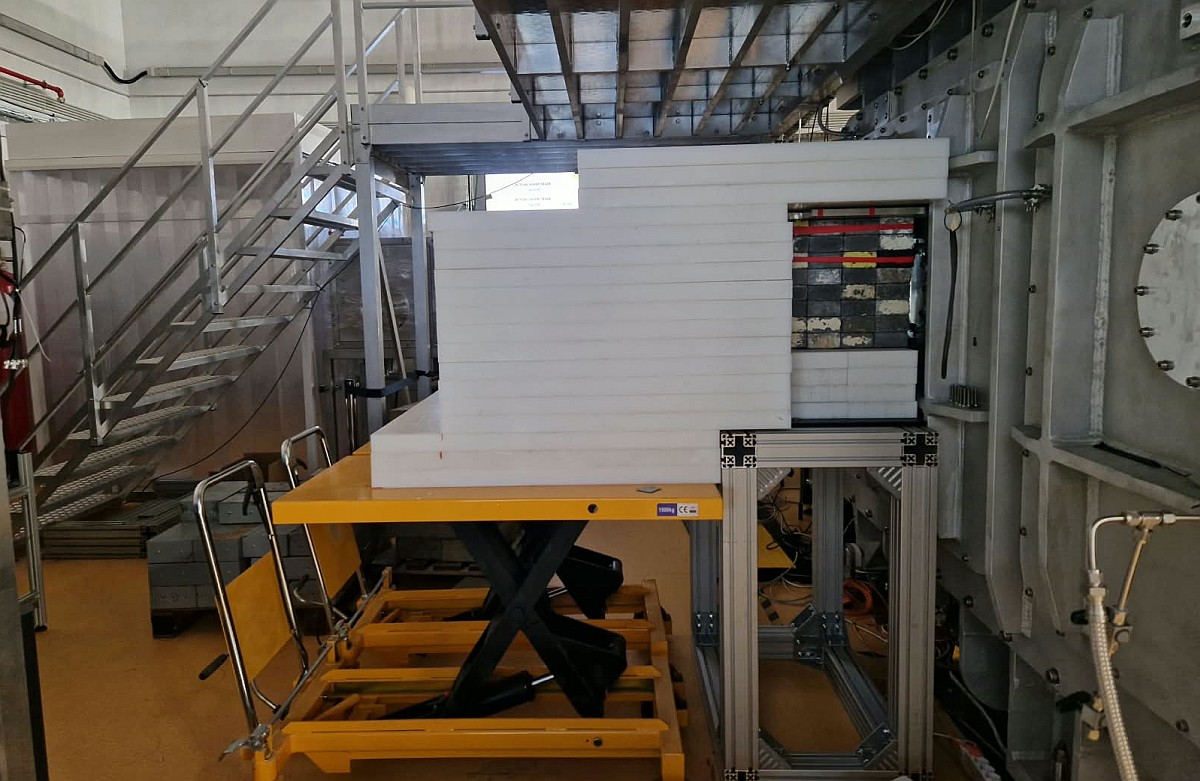
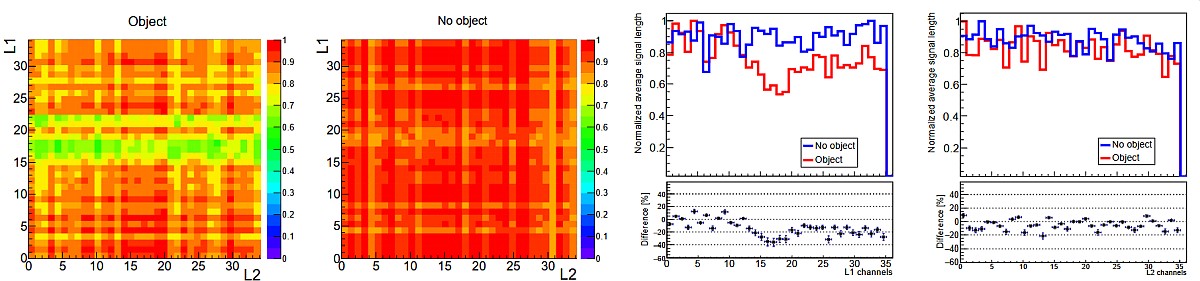
The laser pulse was focused onto a 60 mm long gas target, generating a bright, high-energy electron beam through the well-established laser wakefield acceleration (LWFA) mechanism. The resulting GeV-scale electrons were directed onto a lead converter, where they produced high-energy photons through bremsstrahlung. These photons then generated muon-antimuon pairs via the Bethe-Heitler process. Extensive simulations, carried out in particular by PhD student Madalina Dobre, were used to optimise muon production and suppress the unwanted secondary particles (e.g., electrons, positrons, neutrons, gamma rays) inevitably produced during the interaction. The aim was to maximise the muon fraction of the resulting mixed particle beam. The team measured the muon beam profile using large plate detectors developed by the Astroparticle Physics Group primarily for atmospheric muons. The artificial muon beam was also used to radiograph a test structure made of lead blocks. Although some residual background remained, about 90% of the detected signal came from muons, with the remaining 10% from other particles. This background was essentially uniform across the two-dimensional image and therefore did not significantly affect the image contrast and quality. To our knowledge, this is the first demonstration of muon imaging with a laser-driven muon beam of such high purity (see Figure 1).
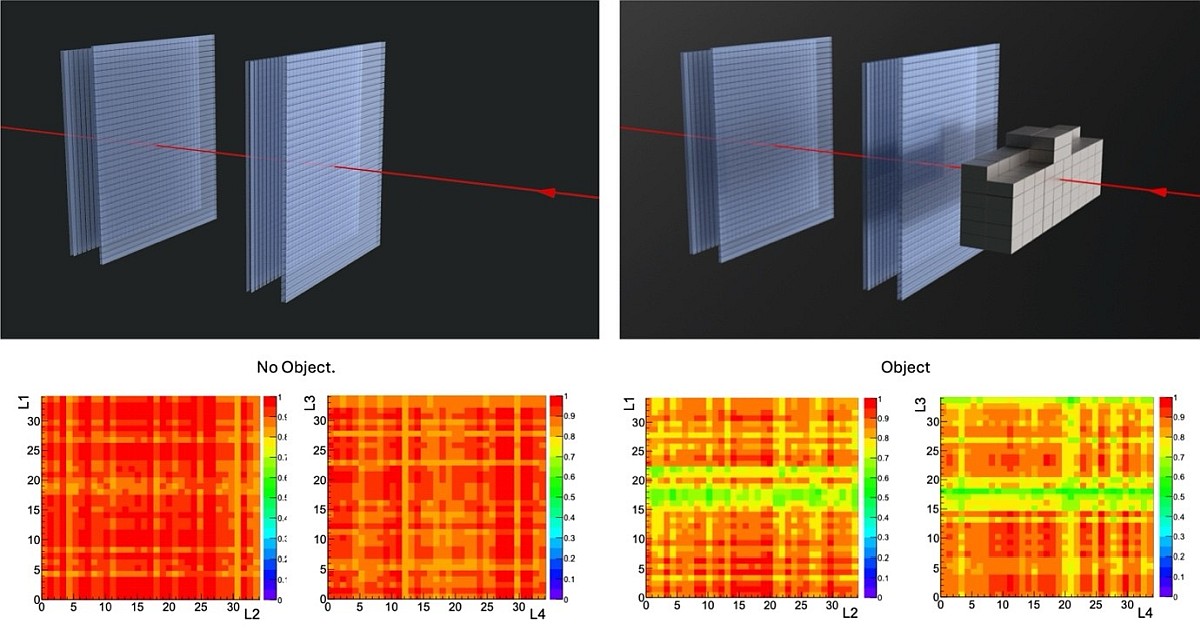
Figure1: Muon radiography of a lead structure using the laser-driven generated muons at ELI-NP.
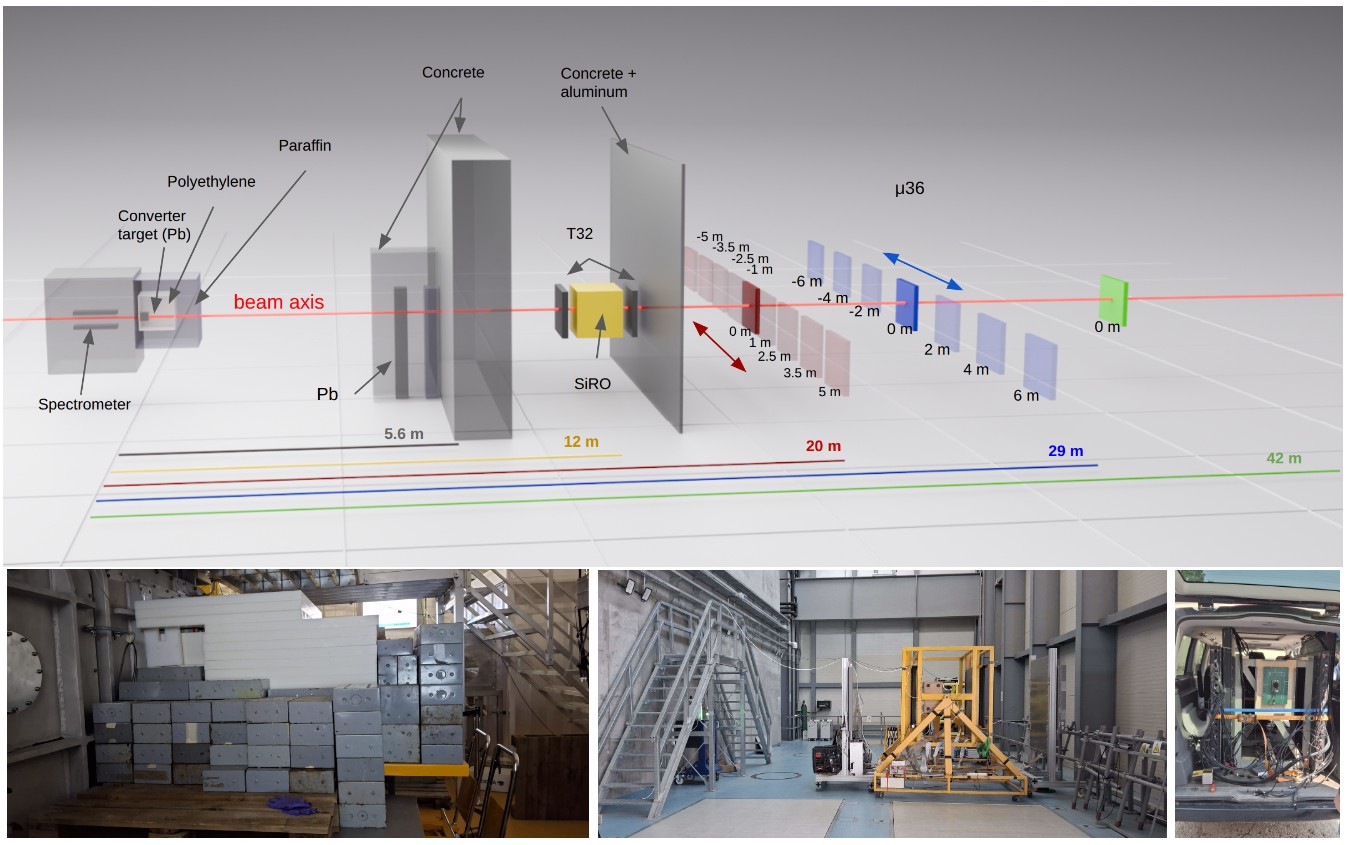
Schematic of the experimental set-up (not to scale), showing the converter target, building walls, and the detector ; Partially assembled shielding during the set-up phase ; The SiRO detector ; The detector assembled inside a van, with the detection modules oriented perpendicular to the beam axis