Josh P. Peters, Florin Teleanu, Huijing Zou, Ehtisham Rasool, Farhad Haj Mohamad, Heiner Schafer, Jan-Bernd Hovener, Alexej Jerschow & Andrey N. Pravdivtsev
[ https://www.nature.com/articles/s41467-026-73214-w ]
A team of researchers from Kiel University, New York University, and ELI-NP Romania has solved one of the most stubborn obstacles in hyperpolarized MRI: signal that fades too fast to be clinically useful. Their study, published in Nature Communications, demonstrates that the 13C polarization lifetime of pyruvate - the workhorse probe for metabolic tumor imaging - can be extended from roughly 30 seconds in standard conditions to over four minutes under an optimized protocol.
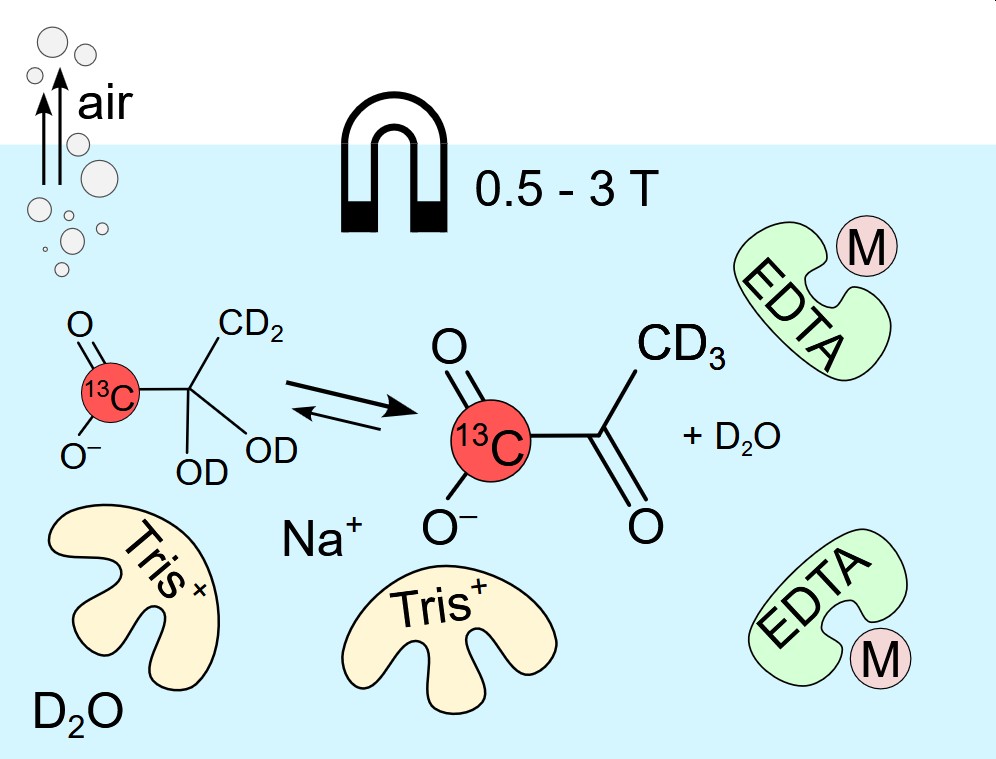
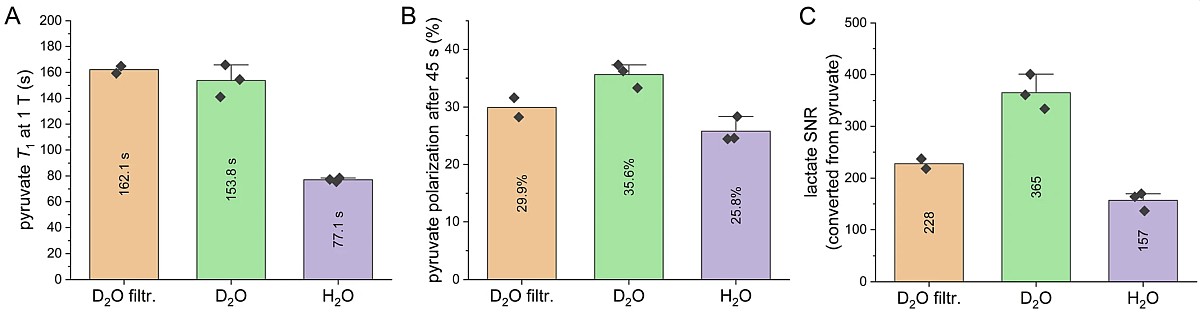
The key insight was that polarization losses happen predominantly at low magnetic fields during transport from the polarizer to the scanner - a regime that had been largely ignored in previous studies conducted at high field. By systematically mapping relaxation across fields from 8 μT to 9.4 T, the team identified the compounding loss mechanisms. Each was addressed in turn and sequentially eliminated such that, for in vitro cancer experiment using HeLa cells, the optimized protocol more than doubled the lactate signal compared to the standard clinical preparation.
Optimizing the sample composition could lead to a 2.6-times increase in signal-to-noise ratio, and more than doubled metabolic sensitivity in cancer cell experiments, significantly extending the detection time window for future in-vivo studies.